Cooperative board games, explained
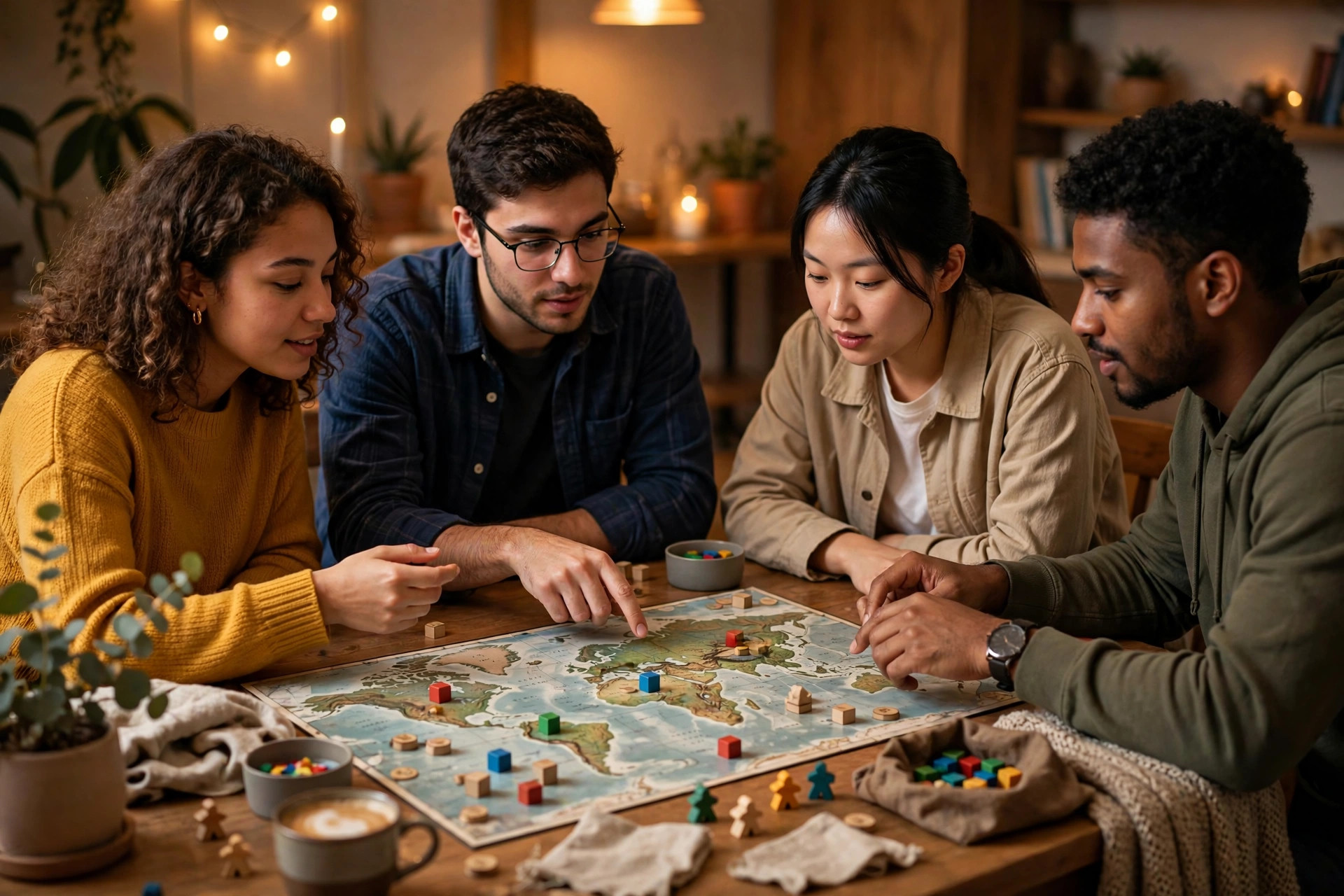
Most board games end with one winner and everyone else doing polite maths about how close they came. Cooperative games throw that script out. Everyone sits on the same side of the table, the game itself supplies the opposition, and the group either reaches its shared objective together or loses together. That single change — shared victory, shared defeat — reshapes everything about how a session feels, who it suits, and what can go wrong. This guide explains how cooperative play actually works, the main structures designers use, and how to run a first session that leaves people wanting a second one.
What makes a game cooperative
The definition is stricter than it first sounds. In a cooperative board game, players work together to achieve a common goal rather than competing against each other, and the outcome is collective: reach the predetermined objective and everyone wins, miss it and everyone loses. That is different from a noncompetitive game with no victory condition at all, where there is nothing to win or lose, and it is also different from team games where two partnerships compete — temporary teamwork inside a competitive game does not make it cooperative. If one person can still win alone at the end, the game is not a true co-op, however friendly it feels along the way.
Because no human opponent is driving the challenge, the game system has to do that work instead. Designers build pressure in a few recurring ways: a timer in the form of a shrinking board or a deck that runs out, escalating events that get worse the longer the game lasts, and limited actions that force the group to choose which problem to leave unsolved this round. Good cooperative design makes the group feel clever for surviving that pressure, not punished by randomness. When a co-op feels flat, it is usually because the pressure is either too predictable to discuss or too chaotic to plan around.
Two anchor examples worth knowing
Pandemic, designed by Matt Leacock and published by Z-Man Games, is the reference point most players meet first. It supports 2 to 4 players in about 45 minutes, and casts the group as disease-fighting specialists trying to discover cures for four diseases before the board situation gets out of hand. Each player takes a specialist role, and the tension comes from coordinating movement and card exchanges across a world map while infections keep landing in new places. It remains the clearest illustration of the classic co-op bargain: simple individual turns, hard collective decisions.
Forbidden Island offers the lighter end of the same idea. The game is built from 24 island tiles, and each player receives an adventurer role with a slightly different ability. On a turn, players move, shore up flooded tiles, pass treasure cards, or capture a treasure, while flood cards steadily flip tiles to their underwater side — and a tile flooded twice is removed from the island entirely. The shrinking island is the whole lesson in miniature: the group can see exactly what it is losing, turn by turn, and has to agree on what to save. For a group that has never played cooperatively, that visible, physical pressure is easier to grasp than an abstract score track.
The main structures, compared
Not all cooperative games create teamwork the same way. The table below compares the structures a new buyer is most likely to meet, using the anchor games above for the stated player counts and times.
| Structure | How teamwork happens | Example | Stated players / time | Watch out for |
|---|---|---|---|---|
| Open-information puzzle | All information is public; the group plans together openly | Pandemic | 2–4 players, about 45 minutes | One confident player directing every turn |
| Hidden-information co-op | Each player holds information the others cannot see, so no one can plan alone | Described in co-op roundups as a structural answer to dominance | Varies by title | Frustration when clues are misread |
| Shrinking-board race | The board itself deteriorates; the group triages what to save | Forbidden Island | 2–4 players | Early losses can snowball |
The comparison matters because the right structure depends on the group, not on which game is most acclaimed. A group that loves open debate will enjoy an open-information puzzle and may find hidden information annoying. A group with one dominant strategist and three quieter players often has a better night with a hidden-information design, precisely because the rules — not politeness — force everyone to contribute. Structure first, theme second, is a reliable buying order for cooperative games.
The alpha-player problem, honestly
Every cooperative guide eventually meets the same objection: what stops one experienced player from simply telling everyone else what to do? The honest answer is that nothing in a rulebook fully stops it, but design can make it harder. Roundups of cooperative games make exactly this point about hidden-information titles: when information is physically divided between players, one person cannot dominate every turn, because they literally do not hold all the facts. Rotating who speaks first, timeboxing long strategy debates, and agreeing discussion ground rules before the first game are the social half of the same fix.
There is also a teaching dimension. The player who knows the game best often takes over with good intentions — efficiency feels like kindness mid-game. It rarely lands that way. New players remember whether they made real decisions, not whether the group won. A win that someone else engineered on your behalf is a surprisingly weak advertisement for a second session, while a close loss full of genuine group calls is a strong one. If the goal is a group that plays again, protecting everyone's agency matters more than protecting the win.
A decision framework for choosing your first co-op
Work through four questions in order. First, how does your group handle losing together? Groups that enjoy debriefing a loss suit harder, tighter designs; groups playing mainly to relax should start lighter. Second, how much hidden information can the group tolerate? If miscommunication reads as comedy, hidden-information games shine; if it reads as blame, stay with open information. Third, how long will the group genuinely sit for? Match the box's stated time to the group's real attention, not its optimistic estimate — a stated 45 minutes is a sensible ceiling for a first cooperative night. Fourth, does anyone in the group need a defined role to join in? Role-based games, where each player has a distinct ability, give quieter players a built-in reason to speak: their character can do something nobody else can.
Notice what is not on that list: theme-first shopping and difficulty bragging rights. Theme matters for table appeal, and it is a fine tiebreaker between two structurally suitable games. But a beautifully themed game whose structure fights the group will stay on the shelf, while a plain-looking game whose structure fits will get played until the box corners soften. Buy the structure; let the theme break ties.
Your first cooperative session: a procedure
This is a how-to, so here is a concrete routine for a first session with a new group.
- Pick the lighter suitable game. From the framework above, choose the structurally right game at the easier end of its difficulty settings if it offers them.
- Teach the goal and the loss condition first. Before any turn detail, state plainly what winning looks like and the two or three ways the group can lose. New players orient around stakes, not action lists.
- Agree on discussion rules. Thirty seconds is enough: anyone can propose, the player whose turn it is decides, and advice stays a suggestion. Say it out loud before turn one.
- Play two open practice rounds. Talk through the first two rounds slowly and collectively, then let normal turn order take over.
- Name decisions as they happen. When the group faces a genuine fork, pause and let each player argue a side briefly. Those forks are the game; rushing them wastes the best part.
- Debrief for two minutes at the end. Win or lose, ask what the turning point was. Groups that debrief tend to ask for a rematch on the spot.
What success looks like: every player can point to at least one decision that was genuinely theirs, the group can explain why it won or lost in one sentence, and at least one person asks when the next session is. If all three hold, the structure fit the group — buy deeper into that structure, not randomly across the category.
Common questions
Are cooperative games good for mixed experience levels? Often, yes — beginners can learn from experienced players while still contributing, because the goal is shared. The risk is the dominance problem above, which structure and discussion rules manage better than good intentions do.
Can cooperative games be played alone? Many can, since the opposition is the game system rather than another person; roundups note several well-known co-ops include dedicated solo rules. The solo guide on this site covers that in depth.
Is a game with a traitor still cooperative? Not in the strict sense used here. If one player can win by making the group lose, the outcome is no longer shared by everyone, and the game sits in a neighbouring category with its own pleasures.
Cooperative games earn their shelf space by doing something competitive games cannot: they make the whole table celebrate or groan at the same moment, for the same reason. Choose the structure that fits your people, protect everyone's decisions in the first session, and the category tends to sell itself from there.